

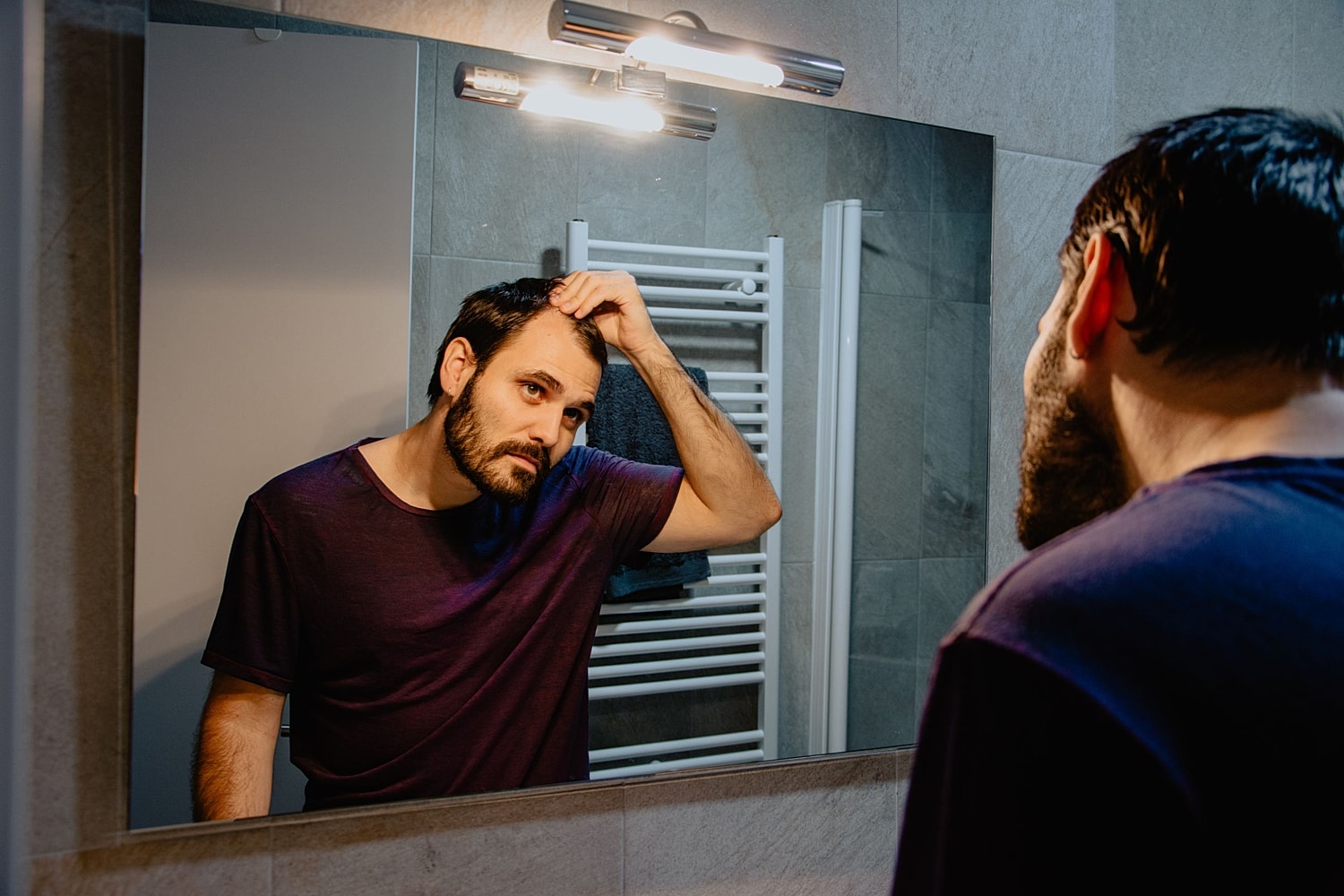
Hair loss is a gradual process. You might see a few more hairs in the sink or notice your crown feels a bit thinner than it used to. Today, people are very open about how they keep their hair looking good. Hair restoration is a regular part of that talk. Going to a surgeon to get help isn’t (and never should have been) a taboo subject.
Choosing the right way to fix thinning depends on your own body and how much hair you have lost. Two of the most common approaches we look at: NeoGraft hair transplant surgery and biological boosters like platelet rich plasma (PRP) or PRF. These are not competing options. They solve different problems. Finding the one that fits you is the first step in your treatment plan.
Most hair loss comes down to a combination of genetics and the natural aging process. The vast majority of my patients are dealing with a biological clock that has shortened the growth cycle of their hair follicles.
This thinning usually happens in predictable patterns. Every scalp has its own unique layout. Some people see a receding hairline that changes the frame of their face. Others notice a thinning across the top. Understanding these patterns is the first step in creating your plan. We look at the hair you are missing today and the hair you will have ten years from now.
Choosing the right way to fix thinning depends on your own body and how much hair you have lost. We usually look at three different paths: NeoGraft hair transplant surgery, biological boosters like platelet rich plasma (PRP) or PRF, and topical care. These are not competing options. They solve different problems.
Treatment | What It Does | Best For | Timeline | Longevity |
|---|---|---|---|---|
| Topical Treatments | Helps slow hair loss and support growth | Early or preventative care | 3–6 months | Ongoing use required |
| PRP / PRF | Stimulates existing follicles and improves thickness | Early thinning or shedding | 3–6 months | Requires maintenance |
| FUE Hair Transplant | Relocates permanent hair follicles to thinning areas | Moderate to advanced loss | 9–12 months | Permanent |
The main difference between surgical options and other treatments is what they do for your scalp.
NeoGraft is a corrective fix. It’s for the person who has already dealt with permanent hair loss or a receding hairline. We harvest individual hair follicles from a donor site, usually the hair-bearing scalp at the back of the head, and move them to the bald areas. This puts new hair where it stopped growing.
Therapies like platelet-rich plasma are more about maintenance. These treatments use growth factors from your own body to wake up your hair follicles. It helps promote hair growth in areas with thinning hair. It doesn't move hair around. It just makes the hair you still have thicker and stronger.
"The choice is about what you have to work with," Dr. Fortes says. "If the follicles are gone, we use a hair transplant to replace them. If the hair is just thinning, we use biological treatments to strengthen it and stave off more loss."
NeoGraft
PRP/PRF
The earlier hair loss begins, the more we need to stay ahead of it. If you have a family history of genetic hair loss, you might see permanent hair loss sooner.
When you see a surgeon, they look closely at your scalp skin. Sometimes we take a small sample of the skin to make sure a medical problem isn't the cause of the hair loss. But for most people, it’s just standard hair thinning.
"Starting early is key," says Dr. Fortes. "If we start a treatment plan while you still have a good amount of hair, we can often avoid a bigger surgery later."
These two paths work on different schedules. You won't see new hair growth the next day with either one.
With follicular unit extraction, you have to be patient. After the surgery, the transplanted hair will actually fall out. This is a normal part of the growth phase. The follicles stay alive under the skin. You will start to see hair regrowth in about three or four months, and full hair density shows up about a year later.
With platelet rich plasma or PRF, you might see better hair texture in a few months. This treatment helps promote hair growth by keeping your follicles active longer. It is a great way to combat hair loss without a big procedure, but it is not a permanent solution like a hair transplant.
Modern hair restoration techniques are designed to be comfortable and minimally disruptive, with far less downtime than older methods.
Traditional hair transplants often left a noticeable linear scar. Newer techniques like NeoGraft use individual follicle extraction instead.
“The scarring appears as tiny, pinpoint marks,” says Dr. Fortes. “Even when examined closely, the donor area typically looks very natural.”
The procedure takes several hours, but discomfort is usually minimal. Mild swelling may occur and typically resolves quickly.
Non-surgical treatments using growth factors involve little to no downtime. Since there are no incisions, there is no scarring. Some patients may experience mild tenderness or swelling at injection sites, but most return to normal activities the same day.
There is no standard hairline. Whether you have a bald spot or general thinning, the goal is to find a treatment that works for you. By knowing the different types of hair options, you can take control of your hair growth. Whether you choose follicular unit extraction or a biological boost, the goal is to make sure your hair looks as good as you feel.
Dr. Paul F. Fortes, a distinguished, dual-board-certified plastic surgeon based in Houston, TX, offers an elite standard of care defined by a rare blend of artistic sensibility and scientific rigor. Dr. Fortes believes superior aesthetic results are never "off the rack," but are meticulously customized and individually crafted to meet each patient’s unique vision. He approaches every procedure with the precision of an artisan, ensuring the safest, most harmonious, and exquisitely detailed outcomes that stand apart from the ordinary.
Trusting your aesthetic goals to Dr. Fortes means placing your care in the hands of a provider with impeccable credentials. A graduate of Rice University (Magna Cum Laude) and an inductee of the exclusive Alpha Omega Alpha Honor Medical Society, he completed an extensive eight-year surgical residency, including three years of specialized plastic surgery training at the prestigious Northwestern Medical Center in Chicago. Recognized for over a decade as a Texas Super Doctor, Dr. Fortes affirms his position as a preeminent leader, solidifying him as THE trusted expert for those seeking truly transformative, beautiful, and enduring results.